Sweden: an amendment to the short-time working scheme allows for a reduction in activity of up to 80%.
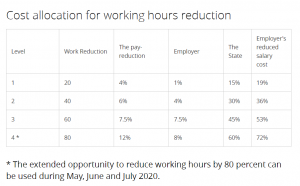
On 27 May, Parliament adopted the government's plan to augment the short-time working system (Korttidspermittering) by allowing up to an 80% reduction in working hours in May, June and July, compared with a maximum 60% previously. Employers can agree with their employees on a reduction in working hours for a period of six months, with the potential for a further three month extension if needed due to the Covid-crisis. The costs the scheme will be shared between the State, employers, and employees. With the earlier scheme employers could reduce employees' working hours by up to 60% and employees received 92.5% of their salary during this period. Under the new regulations, employers can reduce the working time of employees by up to 80%; employers would pay 8% of the non-working salary, the state would compensate 60%, and employees would bear 12% of the costs. The table below summarizes the breakdown of the costs according to working time reduction levels.
Enjoy this article for free while you’re in your trial period
You have access to our content for 1 month.

In order to implement this short-time working, employers must conclude an agreement with employees if there is no applicable collective agreement, and if there is a collective agreement, then the agreement must be concluded with the relevant trade unions. The table below shows the distribution of costs between employees, employers and the state for the reduction of working hours.Sweden: an amendment to the short-time working scheme allows for a reduction in activity of up to 80%.


Source: Swedi

Do you have information to share with us?
What you absolutely must read this week
The essential content of the week selected by the editorial team.
See all
EU: insurance sector social partners commit to addressing violence and harassment at work
The news. The trade union UNI Europa Finance and the employers’ federations Insurance Europe, Amice and Bipar signed an addendum to their 2022 joint declaration on diversity and inclusion on...
18 September 2026
Juliette Baudry (Boiron): “An intergenerational mechanism to better accommodate different life stages”
Since 1 September 2026, employees of the pharmaceutical group Boiron (1,700 employees in France) have benefited from a “key life moments account”. Resulting from an agreement signed last February...
18 September 2026
France: final document on the work of the Labour, Employment and Pensions Conference
After six months of discussions between French social partners, the guarantors of the Labour, Employment and Pensions Conference submitted the conclusions of the discussions to the Prime Minister...
17 September 2026
EU: Commission proposes a list of worker-related criteria for public procurement
The news. On 9 September, the European Commission published a proposal for a regulation aimed at unifying European public procurement law, which accounts for 15% of European GDP. It is notably set...
17 September 2026
Most viewed articles of the month on mind HR
What readers clicked on the most last month.
1
United Kingdom: government launches consultation on AI and data protection rules
L’info. Le gouvernement britannique a lancé, du 15 juillet au 9 septembre 2026, une consultation afin d’identifier les dispositifs juridiques, techniques et de gouvernance...
28 August 2026
2
EU: social partners set out position on guidelines for the sustainability due diligence directive
The news. Following the final adoption of the omnibus directive in February, the European Commission launched a consultation in June aimed at guiding it in drafting guidelines on the application...
28 August 2026
3
Import bans on forced labor products are multiplying
Under pressure from new US tariffs, many countries have presented texts in recent weeks to ban the import of products made with forced labor. A real breakthrough for workers' rights or a mere...
9 September 2026
4
Canada: a sustainability due diligence proposal on forced labour submitted for consultation
The facts. On July 27, the Canadian government launched a consultation to introduce mandatory corporate due diligence measures regarding forced labor. It plans to require risk identification, the...
25 August 2026
5
Germany: a “simplification” proposal for the Corporate Governance Code
In early August, the Government Commission presented proposals to reform the Deutscher Corporate Governance Kodex (DCGK), Germany’s Corporate Governance Code. The proposals are primarily aimed at...
31 August 2026
6
Slovakia: a bill to “clarify” personal data protection measures
The news. The Slovak government approved a bill on personal data protection on August 26, 2026. This text aims to clarify existing regulations regarding employees’ rights and...
7 September 2026