
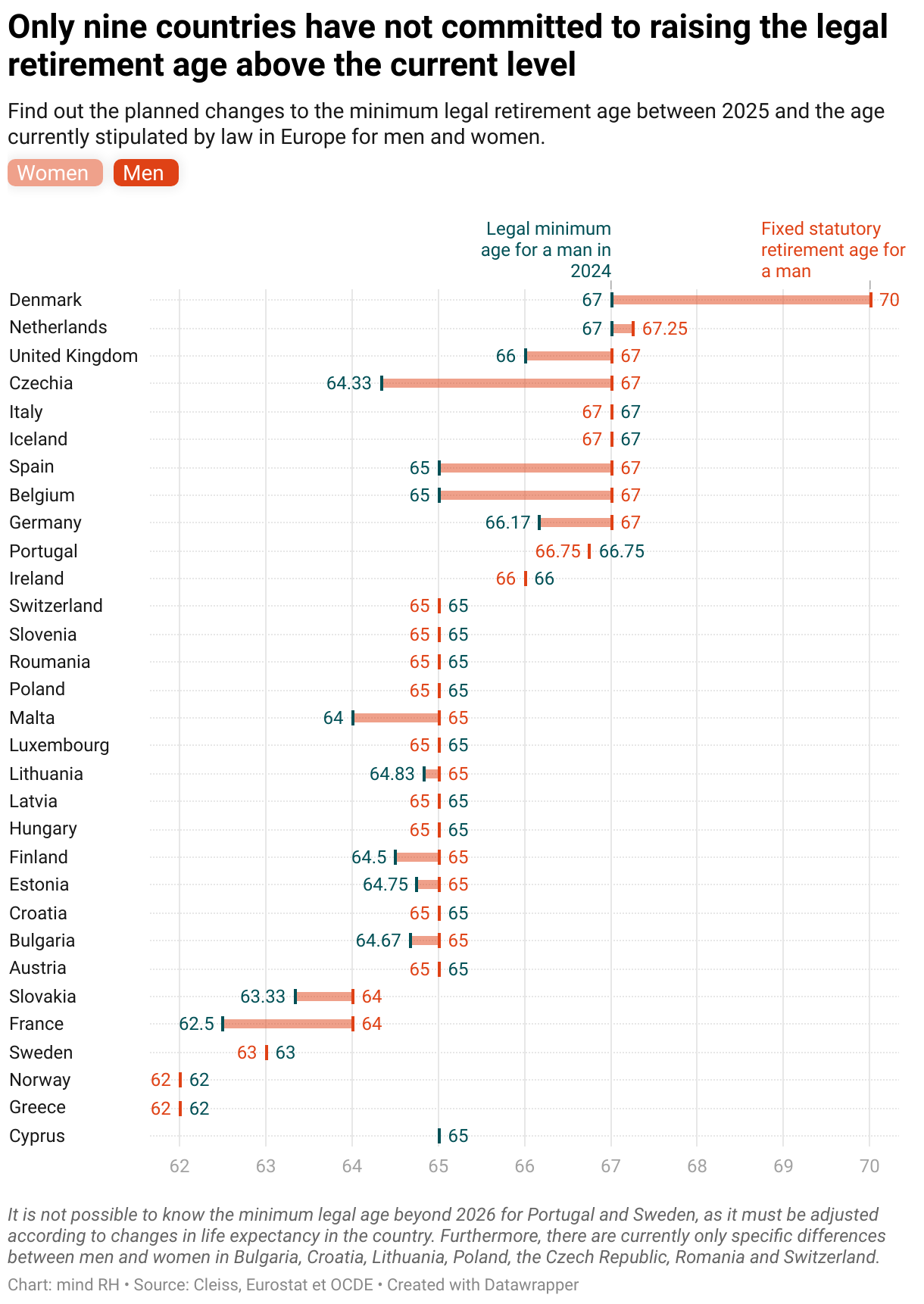
Governments across Europe are increasingly looking to higher statutory retirement ages as a key tool to boost employment among older workers and preserve the sustainability of pension systems. Of the 31 countries studied by mind RH, 16 have been gradually raising the retirement age for more than 10 years now, such as Germany (starting in 2012), or are preparing to do so, like the UK, which has planned to raise the age from 66 to 67 between 2026 and 2028. The subject is also currently being debated in Germany, despite a reform already underway to extend the length of careers. Some economists in Germany are suggesting raising the retirement age to 69 or 70, compared with 67 today. This idea was supported this summer by Germany’s conservative economy minister Katherina Reiche, which immediately triggered the ire of the Social Democrats. In Luxembourg, prime minister Luc Frieden was forced to abandon his plans to raise the retirement age in the face of an outcry from the unions. The statutory retirement age remains 65, but the government has announced that the conditions for early retirement from the age of 60 will be gradually tightened, with the required contribution periods extended by eight months between now and 2030.
Towards an average retirement age of 65
The vast majority of European countries (27 out of 31) have introduced a statutory retirement age of 65 or over. Norway has even recently set this at 70, with effect from 2040. For the moment, only Greece is maintaining a retirement age of 62, subject to 40 years’ insurance cover.

