mind RH analysis: Pay rises shrink at France’s large companies

Featured image of the article mind RH analysis: Pay rises shrink at France’s large companies
In France, compulsory annual salary negotiations are being disrupted by the growing number of redundancy plans. As inflation returns to normal levels, mind RH sought to ascertain the impact of the economic backdrop on the pay rises negotiated at major groups, according to sector. Between 2024 and 2025, both the amounts negotiated and the proportion of companies granting them have fallen sharply, even before Donald Trump's announcement of tariffs.
Enjoy this article for free while you’re in your trial period
You have access to our content for 1 month.

In 2022, according to the Banque de France, the country’s central bank, companies were granting 5% pay rises on average as part of agreements resulting from compulsory annual negotiations (NAO), driven by a context of high inflation and industrial unrest. Three years on, the labour market is no longer marked by widespread manpower shortages, but by redundancy plans. Michel Houdebine, director of the research, studies and statistics office (DARES) at the French labour ministry, told the parliamentary commission of inquiry into the “failure of public authorities to deal with the proliferation of redundancy plans” that the number of redundancy plans had risen by 27% in one year. While this trend remains moderate, the number of contracts terminated in this context has risen by 131%. This phenomenon, coupled with a fall in the number of jobs created, is changing the balance of power in wage negotiations. “Negotiations are based on companies’ economic room for manoeuvre and their need for attractiveness,” explains Julien Gournay, an expert at Syndex, which advises social and economic committees (ESC) in France. “They are also linked to the social climate and the ability of the social partners to put forward compensation demands.” The Banque de France’s annual survey points to average increases of 2.1% for this year’s NAO, compared with 3.3% in 2024 and 4.3% in 2023.
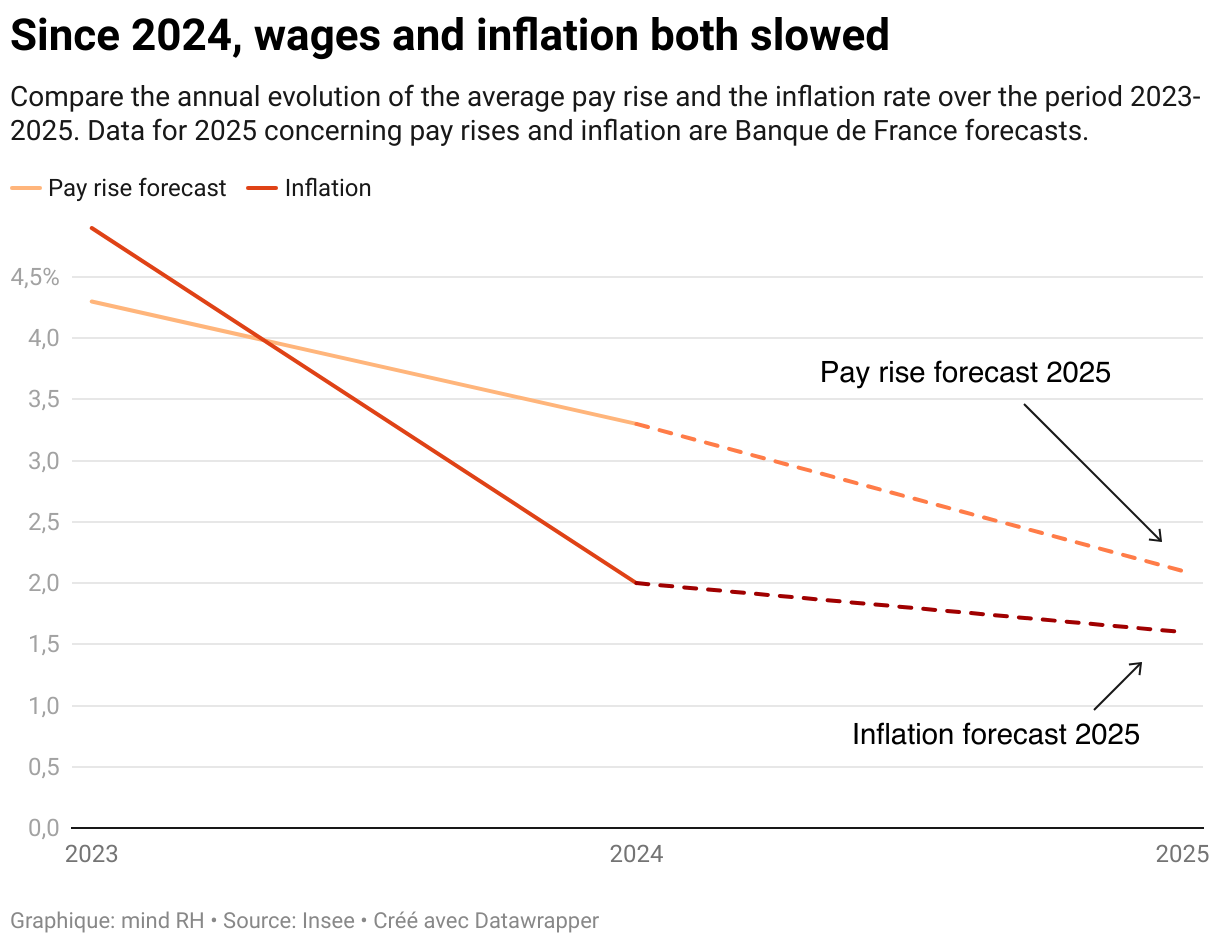
mind RH sought to verify the reality at large companies, the driving forces of the French economy due to their internationalisation and organisations where collective bargaining is nurtured. In order to analyse wage dynamics at these groups, we have compiled a panel of 117 compulsory annual negotiation (NAO) agreements from 82 companies with over 500 employees, belonging to our database of 174 groups in 12 different major sectors (see methodology). 87 of these agreements cover the year 2024, and 30, signed up to the end of February, cover the year 2025.

Fewer and smaller collective pay increases

For 2024, with price rises remaining strong at the start of the period (4.6% inflation in September 2023), almost three out of four agreements (73%) mentioned collective or general pay rises for employees of the companies concerned. This is only the case for six out of ten agreements in 2025. For example, at online bank Boursobank (formerly Boursorama), where a collective increase of 2.5% for employees earning up to €45,000 gross per annum was obtained for last year, management has not granted a budget in this framework for 2025, despite the CFDT’s demand for a 2% increase. In the agreement signed on 2 January, the CFDT cites falling inflation as the main reason. The allocation of general increases in the form of fixed amounts is also down, representing 12.5% in 2025 of those granting a collective increase, compared with 28% the previous year.

Collective increases negotiated in NAO agreements are not only rarer, they are also lower.

You are reading this article thanks to your trial period.
Explore new horizons by checking out our other verticals:
You are reading this article thanks to your subscription to Mind Retail.
Explore new horizons by checking out our other verticals:
Do you have information to share with us?
What you absolutely must read this week
The essential content of the week selected by the editorial team.
See all
UK: trade unions now have a statutory right of access to workplaces 
The news. Since 30 October, British trade unions (certified as independent) have been able to gain physical access to the premises of businesses with more than 21 employees in order to meet staff...
Spain: metal industry employers cut sick pay top-ups
To curb absenteeism, Spanish social partners in the metal sector are introducing new clauses into regional collective agreements to reduce the top-up payments made by employers during sick leave...
2 November 2026
Spain: new rules on working time reduction for caring responsibilities
The news. On 21 October, the Spanish government published a Royal Decree-Law, which came into force on 23 October, facilitating working time adjustments for employees who need to care for a...
France: following the post-Covid boom, large companies scale back on remote working
In the post-pandemic context, large French groups multiplied generous remote working agreements before reversing the trend from 2024 onwards. What is the extent of this phenomenon? mind RH...
Most viewed articles of the month on mind HR
What readers clicked on the most last month.
1
Ireland: minimum wage increase of 5,6% from 1 January 2027
The info. The Irish government has included a minimum wage increase of 79 cents in its Budget 2027, in line with recommendations from the Low Pay Commission. The rate will rise from €14.15...
2
Denmark: government prepares implementation of pay transparency in March 2027
The news. On 8 October, the Danish executive submitted the bill transposing the European Pay Transparency Directive to the national Parliament. The text stems from an agreement between trade...
3
EU: social partners put the Commission in the crossfire over quality jobs
The news. The second phase of social partner consultation on quality jobs ended on 28 September. A mandatory prerequisite for a social initiative in accordance with the Treaty on the Functioning...
4
China: draft bill to strengthen platform workers’ rights
On 8 October, the Chinese government published a draft bill open for consultation aimed at providing minimum guarantees to non-employee platform workers in terms of pay and working conditions. The...
23 October 2026
5
Is a global wage freeze at Volkswagen possible?
The existence of an option to implement a global wage freeze until 2030 has been confirmed by the management of the German group Volkswagen, which nevertheless provides no details and refers to...
20 October 2026
6
France: paid leave for victims of sexual and domestic violence finally adopted
The news. On 13 October, the French National Assembly unanimously approved, among voting members, the “comprehensive bill” aimed at protecting victims of sexual and gender-based...